Lead in Individualized Medicine
One of the key initiatives in the strategic plan is leading in delivering individualized medicine. There are three major initiatives that fall under the umbrella of individualized medicine:
Create clinical facilities of the future to support patient-centered care.
We will undertake major facility upgrades for ambulatory and inpatient services, using the patient and their family's needs as our guidepost.
- Inpatient capacity. There is an immediate lack of inpatient capacity at the Hospital of the University of Pennsylvania. We will solve this in the short-term by reallocating services among the acute care hospitals, expanding inpatient facilities at Penn Presbyterian Medical Center, and improving diagnostic and interventional capabilities at Pennsylvania Hospital. We will also continue the groundwork needed to create state-of-the-art replacement capacity at HUP by 2020.
- Ambulatory capacity. We will expand our regional presence, through additional Practice of the Future sites including Southern Chester County and Central Montgomery County, to increase access to Penn Medicine services. Additionally, with the continued shift to ambulatory delivery we will continue to improve outpatient facilities at all three acute care hospitals.
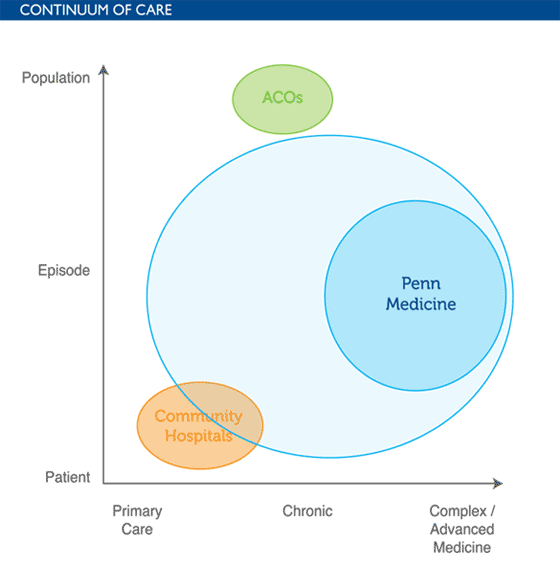
- Affiliated capacity. The focus of care delivery will be broadened to include the role of community-based physicians, hospitals, and Penn Medicine satellites as we develop a distributed network of providers for more population-based payment models.
Optimize the patient experience and coordinate care across disciplines.
- Improve patient access. We will make investments to increase access to care, such as expanded specialty slots, more operating room and inpatient capacity, improved transfer and transport management, and enhanced imaging and consultative services. We will reduce the time and effort required by patients and their families to obtain information, including designing better phone access and introducing online scheduling, an after-hours nurse call center, and check-in kiosks.
- Seamless transitions. We will enhance our ability to care for chronic and complex-care patients by establishing an evidence-based advanced model of primary and episodic team-based care. This will include longitudinal management of patients (supported by expanded ambulatory facilities at Pennsylvania Hospital and Penn Presbyterian Medical Center) and new referral-management with IT linkages for referring primary care physicians, community based specialists, and Penn home care.
- Universal professionalism. Penn Medicine faculty and staff will continue to hold themselves to the highest level of professional conduct, efficiency of service, and compassion and aspire to the highest level of clinical outcomes for our patients.
- Integrated clinical information technology. We will provide the most relevant information to those delivering care, by integrating our inpatient and ambulatory electronic medical record systems into a unified interoperable system by 2017.
- Service excellence. We will improve the patient experience by delivering superior clinical outcomes in a patient centered environment. Action steps required to achieve this goal include developing and promoting well-defined service excellence standards, improving employee selection processes, on-going training for managers and staff, leader rounding, new reward and recognition programs, and rapid experimentation to pilot new methods and processes for improving the patient experience.
Create new models of clinical care delivery and effectiveness.
- Translational Centers of Excellence. To bridge the divide between basic science and clinical care and to bring rapid innovation to our patients, we will establish Translational Centers of Excellence as an organizing vehicle. Initial foci will include, but not limited to, preventing breast cancer recurrence, hematologic malignancies, pancreatic cancer, thoracic cancer, metabolic disease, and neuroscience.
- Excel at complex clinical care and prepare for new payment models. We will strengthen our approach to disease-based service lines with a focus on complex clinical care programs led by multidisciplinary teams. These will include cancer, heart & vascular, neuroscience, musculoskeletal, women's health, transplant, metabolic, and digestive disease. These programs will require shared governance, aligned incentives, team-based decision-making, and the application of research advances. The Clinical Practices of the University of Pennsylvania (CPUP) will establish inter-departmental coordination through shared incentives to produce the optimal outcomes for each patient.
- Launch Innovative Health System Research and Comparative Effectiveness Projects leading to New Outcome Measures. Penn Medicine will assume a national role in developing and testing the safety and effectiveness of treatment protocols and new models for delivering high quality, efficient medical care. We will lead the way in assisting the country in reducing the cost of healthcare through evidenced-based models.
- Center for Personalized Diagnostics and clinical decision-making. With an initial focus on cancer genomics, the Center for Personalized Diagnostics will be an innovative Penn Medicine initiative for developing new approaches to disease classification and individualized treatment protocols.
- Connected health. We will develop IT platforms to assist in managing populations more effectively through an inpatient surveillance system, social media and a "hospital to home" telehealth systems.
- Preventative care. We will continue to promote existing, and develop and test new methods for disease prevention as the ultimate course for improving health outcomes and lowering health care costs.